

I’m hiring an Agentic Orchestration Engineer1 at Mumsnet. We’ll be working together on building AI infrastructure here. If you’re interested in this job, tell me what I got wrong in this essay at evgeny.shadchnev@mumsnet.com.
Lots of people get excited about creating a sophisticated AI setup for themselves: MCP servers connected to their Claude, OpenClaw running on a private server, messages are sent via Whatsapp or Telegram on the go.
It’s useful at a personal level and makes for shiny demos we see on LinkedIn, but it’s not what drives the ROI at the business level.
In this essay, I’ll explain:
Three key layers of AI infrastructure at a business
Intelligence skills layer as the point of maximum leverage
The importance of keeping the data layer clean
Let’s dive in!
Three Layers of AI Infrastructure
You can think of AI infrastructure at a business as three layers:
Access surfaces: Claude, Codex, AI agents in the cloud, etc. This is where a user (a human or AI) expresses the intent to get something done.
Intelligence layer: AI skills, plugins, MCP servers. This is the layer that knows how to get something done using the data available.
Data layer: various data sources your business has.
These three layers span the entire business, so anyone using any access surface can get work done using the shared intelligence layer that knows how to use company data.
The (inferior) alternative is every person operating in a silo instead of working as a team
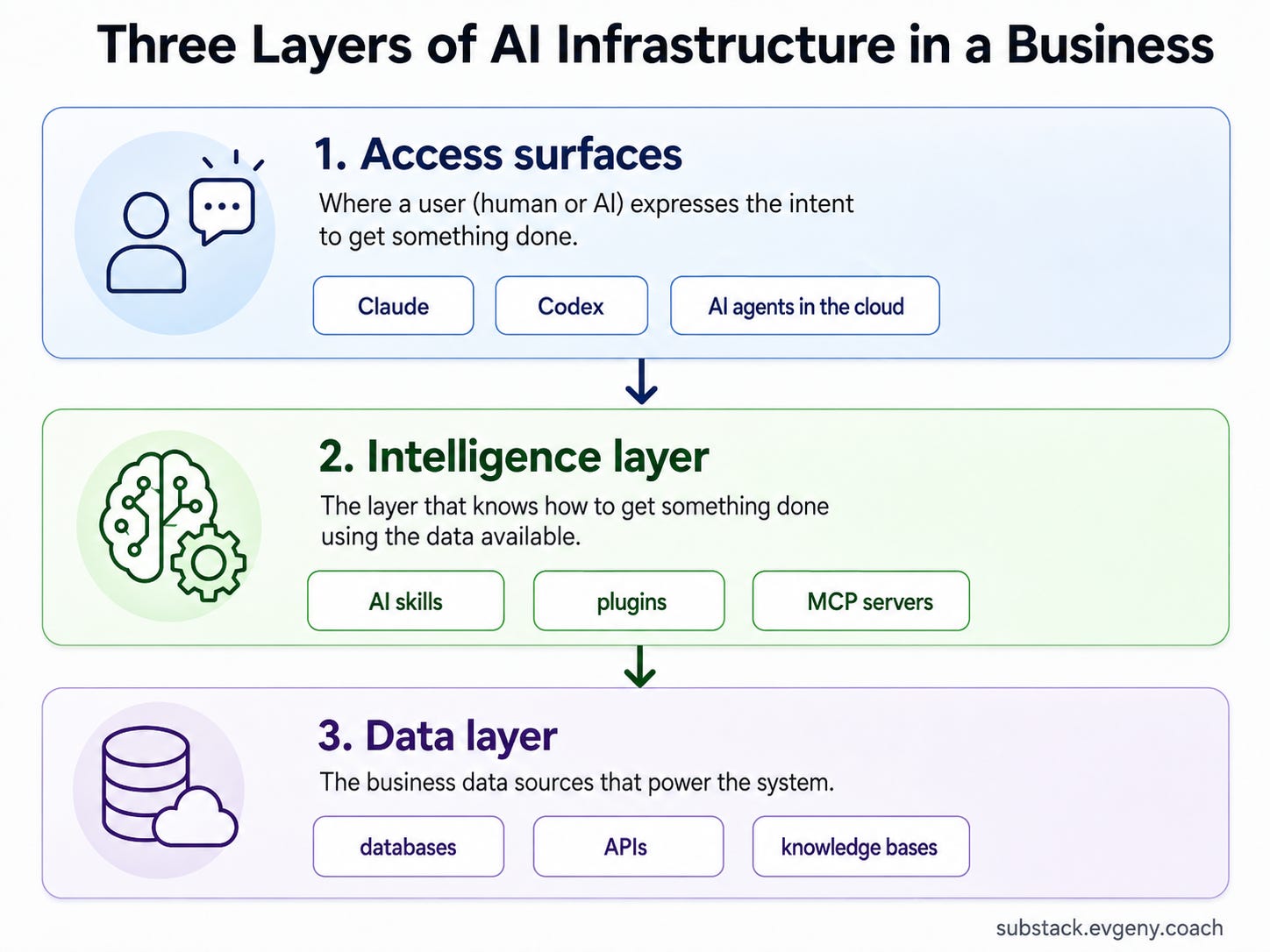
.The AI intelligence layer is the most important. It is a collection of AI skills, agents and MCP servers that know how to do something useful with your data.
This is the new internal software: we used to build internal apps to get stuff done, and now we’re building AI intelligence primitives to do the same.
At the personal level, the situation is simple: let’s just connect my AI agent to my Gmail and my Notion and it’ll do amazing things for me. But at the organisational level, it’s more complicated for three reasons.
First, the data sources are more complicated. Not just Gmail, but various databases and data warehouses that may well contain things like Personally Identifiable Information, which is legally protected, and confidential data. Plus, AI needs to know how to navigate complex data sources, which may well be contradictory.
Second, not everyone in the organisation is technical enough to figure out how this AI thing works. Some people will be running ahead, but if you want to take dozens or hundreds people into the future with you, they will need an easy to follow process, so telling everyone to “connect their AI to an API via an MCP or CLI” in a non-starter.
Lastly, and most importantly, your team needs to collaborate: they need an easy way to share the same AI workflows, build on top of each other’s work and learn from each other. You want to build shared infrastructure, not to encourage everyone to build their own private silo.
The Point of Maximum Leverage: Intelligence Layer
I often see business owners making two mistakes:
Being distracted by impressive but very early-stage solutions, e.g. OpenClaw agents.
Building a setup that works for them individually without thinking how that will translate to the entire team.
Instead, the point of maximum leverage is in the middle layer: making sure your AI intelligence knows how to deliver ROI in a way that’s shared across the team.
In practice, this could mean building AI skills and plugins with Claude (Codex isn’t too far behind) or AI workflows on n8n or similar platforms that capture value-creating processes in your business. Refining them over time builds a compounding advantage for your company.
Keeping the Data Layer Clean
The AI intelligence layer is where proprietary insights and workflows live, but good data is the foundation for making that work.
The aspiration is to make your organisation legible for AI, so that all information it needs is accessible to AI, is not contradictory and is easy to find. This is harder than it sounds because so much critical information in any business is often in someone’s head: “Talk to Sarah who knows how our sales process in France works”. AI can’t do that.
It’s not glamorous work, but that’s where you make the shift from having an impressive demo and something that delivers a return on investment in the bank. Once you have a solid data foundation that your AI intelligence layer can use, any access surface in the business will make a good use of it.
I’m hiring an Agentic Orchestration Engineer at Mumsnet. We’ll be working together on building AI infrastructure here. If you’re interested in this job, tell me what I got wrong in this essay at evgeny.shadchnev@mumsnet.com.
Details below:
At the high level the job is to take Mumsnet into the AI-first future, whether it means building AI agents, training the team, changing their data architecture or choosing the best AI tech providers.
More specifically, in the near-term, the business needs to build a set of AI skills, agents and MCP servers that will help us better leverage the human talent we have, enabling them to focus on what only people are good at. You and I will be driving AI transformation there.
What I’m looking for:
Experience building AI skills and agents, managing the context skilfully. Our platform of choice is Claude, but it could evolve.
Keen interest to learn fast and move fast. We’ll be iterating and experimenting.
An aspiration to build systems operating at levels 4 and 5 of this framework. If we’re reviewing code for QA, we’re not advanced enough.
Probably 1-3 years of dev experience, but if you never had a developer job but are taught yourself how to use Claude Code or Codex at a sophisticated level, please get in touch and share the details.