

We all know the difference between renting a home and having a mortgage. If you rent, you can live there only as long as you pay. And if you have a mortgage, you’re paying it off every month, becoming a tiny bit wealthier in the process and eventually owning the asset.
With AI, if you’re iterating on prompts to get better results, it’s like renting: you’re paying money and attention to do a job, but the AI system is not learning from you1. Your AI system’s knowledge about your work is not compounding.
Using AI in a way that allows it to continuously learn about your world is like having a mortgage. It takes an initial investment, but every time AI does a piece of work for you, it gets better at doing this kind of work thanks to your feedback. Eventually, you build an asset: an AI system that’s really, really good at doing a specific kind of work for your business.
Iterating on a prompt improves one output. Capturing corrections improves every future output. An AI that learns from you in the context of your work will likely beat a smarter AI that knows nothing about it.
Craft, harness and human feedback
Recently I’ve been building an AI project for a client that does complex data analysis. At first, I built it as an AI skill: a set of instructions to do the work, but soon afterwards I realised that the real unlock lies in capturing the lessons from every piece of analysis it’s doing based on human feedback.
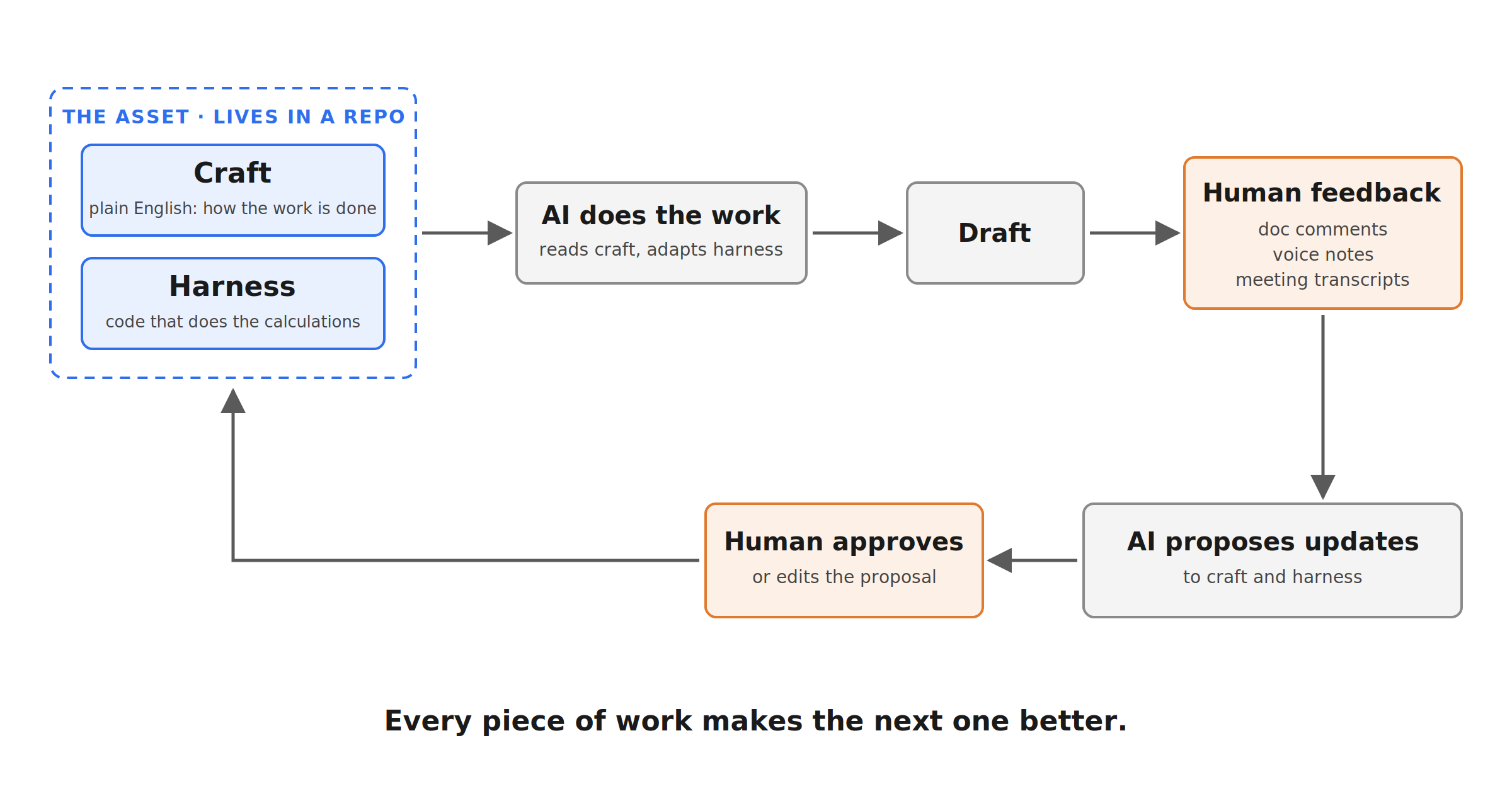
So I approached it with a software engineering mindset. The system consists of two main parts, craft (plain English description of how to do the work) and harness2 (code that does the calculations), plus a feedback mechanism that allows humans to give it ongoing feedback on the drafts, so the final output is a collaboration between humans and AI.
Crucially, after each piece of work is done, the system looks at the feedback it received from humans and translates it into updated craft and harness.
Why not simply use an AI skill?
Both Claude and OpenAI offer a mechanism to capture a workflow, including code and data if needed, as a “skill” and then deploy it across the organisation to reuse. Why not just use that?
Skills are great, but they don’t get better every time they’re used. They don’t learn. Yes, their maintainer can update them, but the skill author doesn’t see the results of their use in the wild or the adjustments the users made to the skill’s work.
Building a mechanism that allows your AI system to learn as it’s being used based on human feedback takes the concept of an AI skill to the next level. It may well be that AI labs will try to build it into Claude Code and ChatGPT but if I were to guess, workflows specific to an organisation are too, well, specific to be easily captured by an off-the-shelf solution, at least for now.
(thanks Joe T for prompting me to clarify this point in the draft)
A fictional example
Meridian is a boutique firm that helps food brands launch in Southern Europe. They know the local landscape very well and give good advice to big brands who want to launch in the region.
Their craft is a detailed description of what they know about their work. An AI agent looks at the client brief, reads the craft, adapts the harness to do the research, and produces a detailed report on how to enter the local market for that client. Craft is just English prose describing how Meridian defines a market, which sources they trust, what a client needs to decide, etc. Harness is code to do the analytical work.
A request comes in for a report on Portugal. An agent produces the draft. A senior partner reads it and leaves feedback: “We never use national retail footfall for Portugal because the Algarve numbers double-count tourists.” This is something a generic AI model wouldn’t know. The partner doesn’t fix the report, she just says it. Then, AI updates the craft and harness and asks a human for approval.3
Two weeks later, when another request about the Iberian peninsula comes in, AI knows not to use national retail footfall for Portugal, and why.
In 2022, such knowledge lived in a partner’s head. Today, it should live in the craft.
Why the loop works
The key idea is ongoing capture of human feedback in written form. Currently, much of human knowledge sits in people’s heads and it can’t easily be captured because it’s genuinely hard for a human being to write down how to do something complex. However, it’s much easier for us to point out mistakes and give feedback. AI then translates that into an artefact it can use.
This is a big deal. Traditionally, expert knowledge has been hard to capture. An experienced lawyer knows if a contract is good or not, but teaching that to a junior lawyer could take years of working together. Writing this knowledge down in its totality is not possible. And when that person leaves, the knowledge leaves with them.
What’s more, providing feedback on AI’s work to help it learn does not require people to adopt any new tools or workflows. Anything — comments on Google Docs, a rambling voice note, a transcription of a meeting discussing the work — can be processed by AI and translated into a better craft and harness.
Not changing existing workflows matters because, let’s be frank, most people hate adopting new tools. Outside of the early AI adopters bubble, most people would rather have less change in how they work. If they aren’t asked to learn anything new, that helps adoption a lot. My colleagues who are asked to leave comments on Google Docs don’t care that their input goes into AI to learn from. What matters is that it’s easy for them.
What it does to the business
If every new analysis is better than the previous one, based on the feedback received from the real world, then this isn’t just an improved prompt or even RAG. Then you have a repository of all the wisdom captured during previous work that can be referenced and applied selectively depending on the task: craft.
What distinguishes craft from fine-tuning a model is that anyone can read it. When two experts disagree on how something should be done, they can look at the craft and decide how to update it because it’s plain English. With fine-tuning, you get a black box you can’t inspect.
With craft, prose is treated as code now. Code is easy to generate for AI, so it’s not the defensible asset it used to be, but prose that describes in fine detail how this particular business does its work is hard to generate because it’s built over time based on real human feedback. Then, that prose can be translated into code and prompts to do that work.
Furthermore, it shifts the balance of power away from big AI labs and towards your business. If craft is plain English, it’s model agnostic. You can swap the vendor underneath and keep the real asset.
I think this is a big deal for knowledge-based service businesses because traditionally they didn’t have economies of scale or much defensibility beyond reputation. If knowledge-intensive work is done by AI systems that are continuously learning from human beings providing feedback, and this knowledge gets continuously captured and refined, it allows such a business to build a defensible, inspectable, sellable asset, while improving the quality of work with every new project delivered. Suddenly the AI systems become valuable in their own right.
Furthermore, the marginal cost of delivering a new piece of work starts to diminish, just like with software, enabling economies of scale that tech companies always enjoyed and knowledge-intensive service businesses never had. Much of the work in the real world can’t be encoded into software only (harness), but if the software is complemented by the craft, describing how to do the work, it allows AI to take on a far greater share of the work.
Traditionally, factories had economies of scale because they could learn from doing the work, and tech companies had zero marginal cost of an extra copy of software. Knowledge-based service work had neither. Now it can have both.
What it does to people
In this model, humans become the glue with the real world. Instead of doing the work, we might specialise on providing feedback on what actually works. Human beings know how the work lands with a particular client, how it resonates with the wider audience, and they can provide that feedback to AI. Our human job then boils down to management: setting the vision and providing ongoing feedback.
The judgement required to do this comes not from doing the grunt work as an apprentice doing the work by hand, but from selling the work to other humans, seeing what real-world impact it has, hearing the feedback from other people and learning how to deliver that feedback to AI to make sure it never makes the same mistake again.
Where it doesn’t work
This approach has its limits. First of all, my system has no idea if the work needs to be done in the first place. It has no wider context. It can do the work but it can’t tell me what work is important. It only learns from people’s comments, not on its own experiments.
Furthermore, craft can drift and become contradictory, much like code needs ongoing refactoring to stay in good shape. What was right for one piece of work might not be right for another. It’ll fall on humans to manage this complexity.
Make sure your AI learns
If you’re using AI, make sure it learns from you and never makes the same mistake twice. Over time, you’ll be building an asset and improving the quality of the work with every delivered project.
If your corrections don’t persist beyond the current conversation with AI, you’re paying rent. Instead, build an asset, a system that learns from feedback, just like you’d be doing with a mortgage.
Other than the labs AI systems may well be learning from you, building their asset.
It’s not a good name since it’s different from what harness means when applied to the code that runs an AI model, e.g. Claude Code itself, but I haven’t come up with a better one yet.
Technically, it opens a pull request that describes changes to craft and harness that a human later merges.